
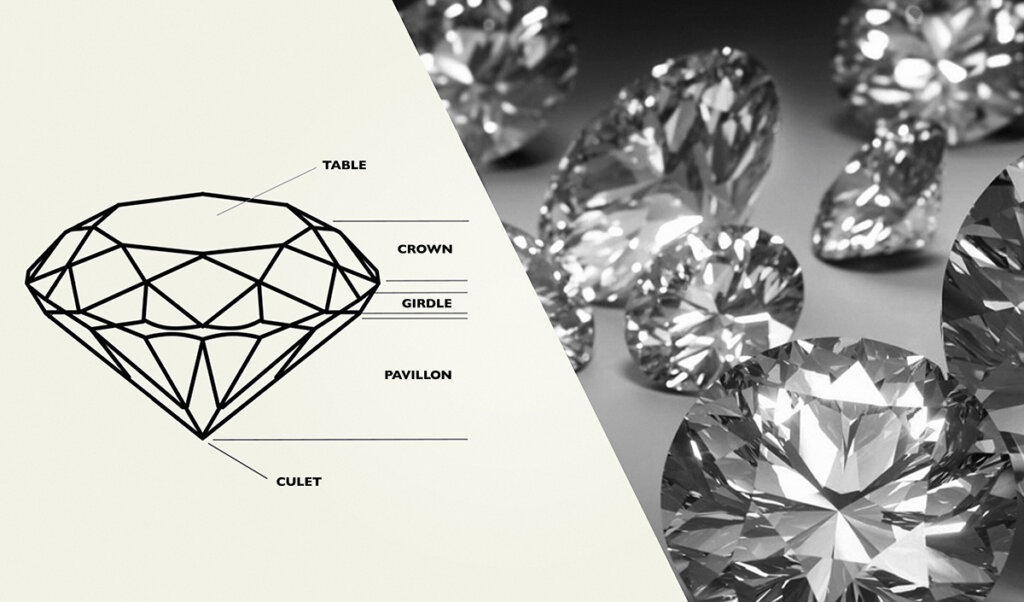
Are “diamond” and “brilliant” the same thing?
In the world of fine jewelry, these two terms are often used interchangeably, leading to easily avoidable confusion. Knowing the difference is your first step toward making an informed, high-value purchase.
What is the difference between a diamond and a brilliant?
The Direct Answer: a diamond is the raw, natural gemstone (the precious carbon material), whereas a brilliant refers exclusively to a specific style of cut designed to maximize light reflection. In short: diamond is the stone, and brilliant is the cut.
Understanding the 4 Cs of Diamond quality
To evaluate the quality and market value of a diamond, gemologists worldwide use a universal standard known as the 4 Cs:
-
Carat (weight): carat refers to the physical weight of the gemstone. One carat is equivalent to exactly 0.2 grams.
-
Color: the color scale ranges from completely colorless (the rarest and most valuable, graded as ‘D’) to light yellow or brown.
-
Clarity: this measures the presence of natural internal characteristics called inclusions. The fewer inclusions a diamond has, the purer and more valuable it is.
-
Cut: the cut is arguably the most crucial factor determining the stone’s sparkle. An excellent cut allows light to enter, bounce inside, and exit the top of the stone in a dazzling display of rainbow flashes (fire) and white light (brilliance).
Who invented the brilliant cut?
The modern round brilliant cut was calculated in 1919 by mathematician and gemologist Marcel Tolkowsky.
By studying the physics of light behavior inside a diamond, Tolkowsky discovered the ideal proportions and angles required to obtain the absolute maximum light return. His formula resulted in a round shape featuring 57 facets (or 58 if we count the culet, the tiny flat point at the bottom apex).
Over a century later, despite countless attempts to create new shapes, Tolkowsky’s round brilliant cut remains the most sparkling and commercially successful gemstone cut in history.
Buyer Beware: a “brilliant” is not always a Diamond
It is crucial to understand that buying a “brilliant” is no guarantee that you are purchasing a genuine diamond.
Because “brilliant” is simply a style of cut, any gemstone—or even cheap glass—can be faceted into a brilliant shape to mimic the sparkle of a diamond.
The Cubic Zirconia trap
A common example is Cubic Zirconia, a synthetic, inexpensive laboratory–created stone used to imitate diamonds. When sellers advertise a “brilliant cubic zirconia” or simply a “brilliant zirconia”, they are selling a cheap synthetic imitation cut in the round brilliant style. Always verify the mineral origin before buying.
Exploring other elegant diamond cuts and shapes
While the round brilliant cut offers the highest light return, other shapes (collectively known as fancy cuts) offer incredible personality, unique styles, and distinct visual advantages:
-
Oval cut: a modern, highly elegant shape that elongates the finger when set in a ring.
-
Marquise (or navette) cut: a football-shaped cut with pointed ends. Because of its elongated surface area, a marquise diamond often looks significantly larger than a round diamond of the exact same carat weight.
-
Heart cut: the ultimate romantic gesture, perfect for a highly personalized engagement ring or anniversary pendant.
Buying diamonds does not have to come with a premium price tag or environmental concerns. Choosing certified pre-loved diamonds is the ultimate smart-luxury secret: you receive a structurally perfect, indestructible natural gemstone at a fraction of its original retail cost.
You can discover numerous diamond jewelry pieces in the Ledial catalog, and if you have a small budget you can opt for cubic zirconia jewelry.